
How a reliable 1000hp 2JZ street build comes together as a matched ecosystem, the weakest-link principle, and why in-stock NZ parts keep it moving.
The dream is the same for almost everyone who gets deep into a JZ: a car that makes silly power, holds a WOF, does skids all weekend and still drives home under its own steam on Sunday night. That last part is the hard part. Plenty of cars hit a big dyno number once. Far fewer do it again and again without grenading something, and that repeatability is the real achievement.
So here is how a reliable 1000hp 2JZ street build actually comes together. Not as a shopping list of hero parts, but as a matched system where every piece is sized to survive the others.
Power is a system, not a parts pile
The mistake that kills engines is treating a build as a collection of impressive individual parts. A huge turbo bolted to a tired bottom end does not make a fast car, it makes an expensive bang. Big power is an ecosystem, and the whole thing is only as strong as its weakest link. Find that weak link, fix it, and you have simply moved the weak link somewhere else. The job is to keep chasing it until everything in the chain can take the load.
At four-figure power on a street 2JZ, that chain runs from the bottom end, through the fuel and tune that keep it safe, out to the cooling, clutch and driveline that have to put it on the road. Skip a link and that is where it breaks.
A bottom end that wants the power
Everything starts here, because at this level the factory internals are long gone. A genuine high-power JZ bottom end is built from matched parts chosen to work together:
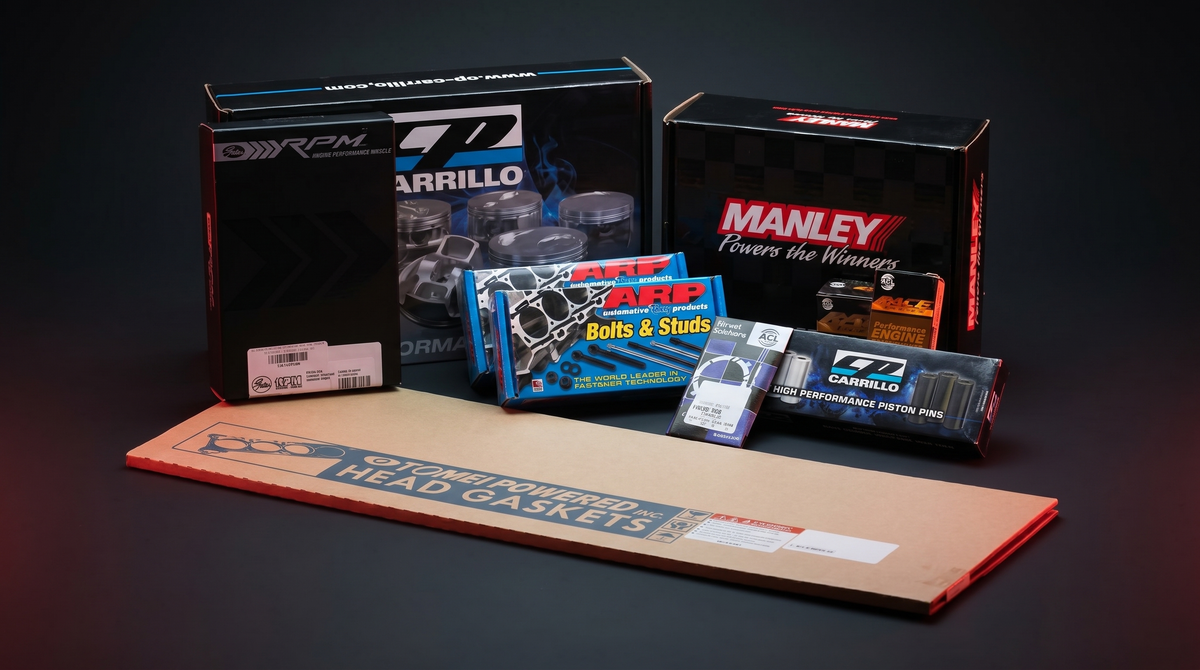
- Forged rods and pistons. The factory rods are the first thing to let go when you push past the safe window, and "Uncle Rod" coming through the block is the failure everyone is trying to avoid. Forged rods and pistons from known names give you the margin to make the power and keep making it.
- Race bearings. The right bearings are cheap relative to what they protect. A spun bearing on a built motor is a heartbreak, so this is not the place to save.
- ARP studs. Head studs that actually clamp the head down are what stop head lift once the boost climbs.
- The right gasket. A proper MLS gasket matched to your bore and the clamping load is what seals all of that together under serious cylinder pressure.
Get the bottom end right and you have removed the most catastrophic and most expensive failure from the equation. Everything after this is about feeding it and harnessing it safely.
Fuel and tune: the parts that keep it safe
You can have the strongest short block in the country and still detonate it to pieces with a fuel system that runs out of breath or a tune that drifts lean. At 1000hp the fuel demand is large and constant, which means a pump and injectors sized for the job, not stretched to their limit. Run a system flat out at its ceiling and you have no margin the day it is hot and the fuel is borderline.
The tune is where the whole build lives or dies. A capable ECU watching knock and managing fuel and timing is the difference between a motor that survives a hard weekend and one that does not. This is also why a good tuner is not optional spend. The dyno operator who knows the platform and tunes it conservatively is buying you reliability that no single part can. Pay for that.
Cooling, clutch and driveline
Heat is the quiet killer of street cars. A 1000hp motor makes enormous heat, and a cooling package that copes on a dyno pull can still heat soak in traffic on a hot day, bring on knock and quietly move your safe limit down. Real cooling is part of the reliability story, not an afterthought.
Then there is putting the power down. A clutch that slips and driveline parts that twist or break will end a weekend just as fast as a blown motor, and they are part of the same weakest-link logic. The clutch, the gearbox and everything behind it have to be rated for the torque, or they become the next thing to fail.
Be honest about what this takes
A genuine, reliable 1000hp street car costs real money, real time and a real tuner. Anyone telling you otherwise is selling you the expensive bang. The flex was never the number on the dyno sheet. The flex is the car that does skids all weekend, passes a WOF and drives home, because that is the build almost nobody actually finishes properly.
Why in-stock-in-NZ parts matter at this level
A build this size has dozens of parts that all need to be on the bench at the right time. The fastest way to stall it for a month is to wait on freight for one missing piece while everything else sits assembled and useless. Parts held in stock here, dispatched by tracked courier, keep the build moving instead of parked. Momentum matters more than people expect, because a stalled project is the one that never gets finished.
This is also where rebuild packages earn their place. Matching internals, studs and gasket yourself means getting every spec, clearance and pairing right across a lot of parts. Our engine rebuild packages take that guesswork out by bundling matched internals for the platform, so the bottom end is sorted as one job rather than a dozen separate gambles.
If you are planning a build like this, talk it through before you start buying. Call 0800 NZ PERFORMANCE (06 359 2100) or use the contact page, tell us your power goal and what is already in the car, and we will help you spec it as one system so the car you end up with is the one that drives home.
Share:
Will It Actually Fit? And Is Importing It Yourself Really Cheaper?