
1JZ VVTi vs non-VVTi explained honestly, plus how to pick cams by goal and why high-lift cams need shimless buckets.
You're staring at two 1JZ blocks in the Trade Me listings and trying to work out which one to base a build on. One's VVTi, one isn't, and every forum thread tells you something different. Some swear the non-VVTi is the "stronger" engine, others say the VVTi makes more usable power. Here's the straight version, plus the cam decision that catches people out and can wreck a fresh head.
1JZ VVTi vs non-VVTi: the honest trade-offs
The big mechanical difference is the variable valve timing gear on the intake cam of the VVTi engine. When Toyota added it, the goal was a fatter, more usable curve. In practice the VVTi 1JZ gives you better low and mid-range torque and more area under the curve, so the engine feels stronger in the part of the rev range you actually drive in. That's genuinely useful on a street car or anything that has to put power down off a corner.
The catch is the timing gear itself. That variable cam gear adds a layer to the tune. Not every tuner has spent time dialling in VVTi control, and a few will quietly steer you toward a non-VVTi setup just because it's one less thing to get right. The non-VVTi engine is simpler: fixed cam timing, nothing extra to map, and it's the one the old-school crowd grew up building. Neither is wrong. It comes down to what you're chasing and who's tuning it.
About the "stronger rods" thing
You'll hear that the non-VVTi 1JZ has stronger rods than the VVTi. Treat that as reputation, not gospel. It's a persistent scene belief that gets repeated as fact, and it's never been a settled, proven difference. Both bottom ends are strong for what they are and both have a ceiling. If you're going for real power, you're forging the bottom end regardless, so the factory rod argument stops mattering pretty quickly. Don't pick a block on a myth. Pick it on what suits your goal, your tuner, and what's actually available in good nick.
So which one
If you want strong street manners, daily-able torque, and you have a tuner comfortable with VVTi control, the VVTi engine is a great base. If you want the simplest possible tune, you're building something more single-purpose, or your tuner prefers it, the non-VVTi is a clean and proven path. Both will make serious power once the internals are sorted.
Choosing cams by your goal, not by the biggest number
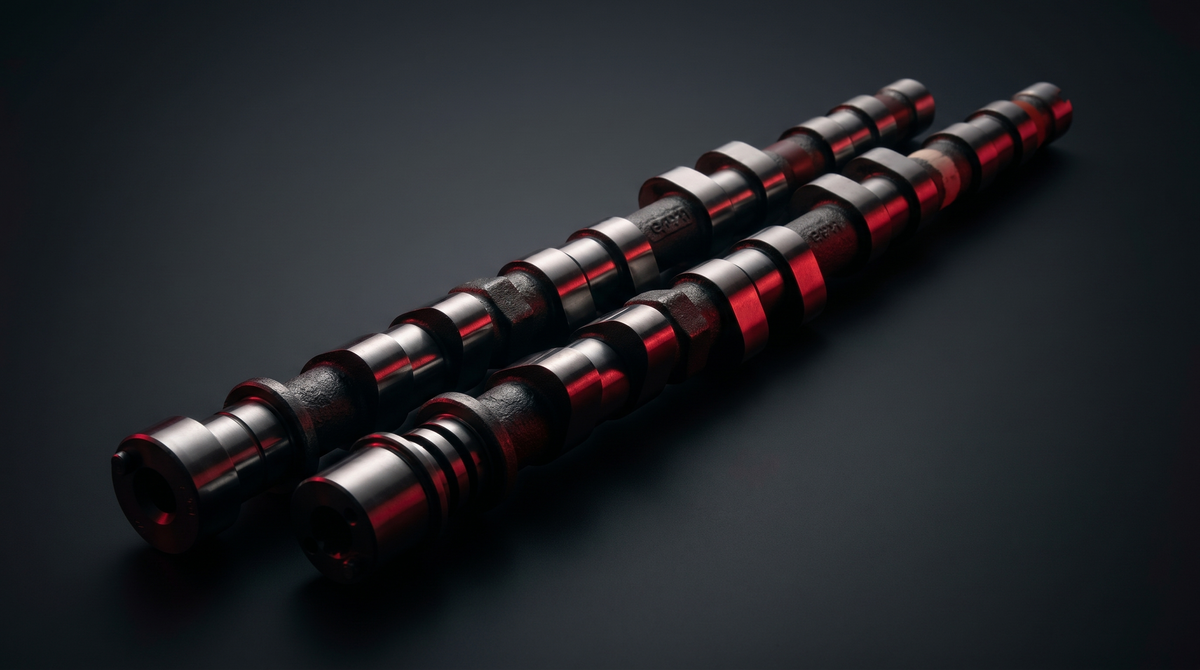
Cams move your power, they don't magically add it everywhere. The two numbers that matter are lift (how far the valve opens) and duration (how long it stays open). More duration shifts the power band up the rev range and frees up the top end, but it can soften the bottom and make the engine lumpier down low. So the cam choice follows the goal:
- Street and response focused: a milder cam keeps your low and mid-range and stays nice to drive.
- Top-end and big-boost focused: more lift and duration to flow at high rpm, accepting a rougher idle and less down low.
Match the cam to where you want the car to live. A big drift or circuit setup wants a different cam to a torquey street car, even on the same block. If you're not sure where your goal lands, that's worth a phone call before you buy, because cams are not a part you want to swap twice.
The trap: high-lift cams and the shim that goes flying
This is the bit that catches people, and it's why valve springs and buckets are part of the cam decision, not an afterthought. The factory JZ valvetrain runs a shim sitting on top of the bucket. That setup is fine at stock lift and stock rpm. Push into high-lift cams, the sort of thing you see at 264 or 272 duration, and chase higher rpm, and the factory shim-over-bucket arrangement can spit a shim out at the top of the rev range. A loose shim rattling around a spinning head is exactly as bad as it sounds, and it can destroy the head.
The fix is a conversion to shimless buckets, where the bucket is a single solid item with no separate shim to lose. If you're going to a high-lift cam, budget for the shimless bucket conversion and the matched valve springs at the same time. The cam, the springs, and the buckets are one package. Buy them together, spec them together, and you keep the head in one piece when the engine's screaming. Skip it to save a few hundred dollars and you can be looking at a wrecked head instead.
This is one of those areas where matched parts beat mix-and-match. The right cam for your goal, springs rated for that lift and rpm, and shimless buckets so nothing comes loose. Get those three talking to each other and the valvetrain just works.
Spec it once, spec it right
VVTi or non-VVTi, the cam decision is the same discipline: pick lift and duration for where you actually want the power, and never run a high-lift cam on the factory shim setup. We stock Kelford Cams with the matching springs and shimless buckets, so the whole valvetrain is specced as one job. If you're weighing up which 1JZ to build or which cam suits your goal, get in touch or call 0800 NZ PERFORMANCE and we'll talk it through before you spend a cent.
Share:
Choosing a Turbo for Your Power Goal, and the Fuel System to Feed It
Will It Pass Cert? Staying WOF-Legal and Sticker-Free in NZ